
2026 PSLE: Challenge of Scoring AL1 in English
The Primary School Leaving Examination (PSLE) is an important milestone for Primary 6 students in Singapore. For students aiming for AL1 in English, however, doing well requires more than being generally “good at English”.
AL1 corresponds to a mark range of 90 and above. This means students need to perform consistently across Writing, Language Use and Comprehension, Listening Comprehension and Oral Communication.
With the 2026 PSLE underway, understanding where marks are commonly lost can help students prepare more strategically.
2026 PSLE English Key Dates
According to the official SEAB examination timetable, the main 2026 PSLE English dates are:
- Oral Examination: 12–13 August
- Listening Comprehension: 15 September
- English Paper 1 and Paper 2: 24 September
- PSLE Marking Exercise: 12–14 October
- Results Release: 24–25 November (tentative)
What Does AL1 Mean for PSLE English?
Under the PSLE Achievement Level system, each Standard-level subject is graded from AL1 to AL8, with AL1 being the highest achievement level. AL1 corresponds to a score of 90 and above.
For English, students are assessed across four different papers:
- Paper 1, Writing: 25%
- Paper 2, Language Use and Comprehension: 45%
- Paper 3, Listening Comprehension: 10%
- Paper 4, Oral Communication: 20%
This is what makes AL1 challenging. A student may be a strong writer but lose marks in comprehension. Another may perform well in Paper 2 but struggle to develop ideas during Oral.
To reach AL1, students need a consistently strong performance across the different language skills rather than relying on one strong component.
Why Is Scoring AL1 for PSLE English Challenging?
1. Writing Requires Both Strong Ideas and Language Accuracy
A good composition is not simply one with an interesting storyline.
Students need to generate relevant ideas, organise them coherently and express them using accurate vocabulary, grammar, punctuation and spelling. These are also reflected in SEAB's assessment objectives for Paper 1.
For Situational Writing, students must also pay close attention to:
- purpose;
- audience;
- context;
- required content; and
- appropriate tone.
For Continuous Writing, students need to develop their ideas sufficiently while maintaining control of their language.
Students aiming for AL1 therefore need to reduce avoidable grammar mistakes while also making their writing clear, engaging and well organised.
2. Paper 2 Requires More Than Finding Answers in the Passage
Comprehension becomes challenging when answers are not directly stated.
Students may need to understand texts at literal, inferential and evaluative levels, while also demonstrating accurate use of vocabulary and grammar in context.
Common difficulties include:
- misunderstanding what a question is asking;
- giving an answer that is too vague;
- identifying evidence without explaining the inference;
- misunderstanding vocabulary in context;
- lifting too much information; and
- missing important details in open-ended comprehension.
For students aiming for AL1, simply understanding the passage is not enough. Their answers also need to be precise and complete.
3. Small Language Errors Can Add Up
English is tested across many different skills, so small mistakes can accumulate.
A student may lose one mark from grammar, another from vocabulary, several from comprehension and a few more from writing.
Individually, each mistake may appear minor. However, when aiming for a score of 90 and above, these losses become significant.
Students should therefore pay attention to recurring errors such as:
- subject-verb agreement;
- verb tense;
- inaccurate word choice;
- incomplete comprehension answers;
- unclear sentence structures; and
- careless spelling or punctuation.
The goal is not perfection in every practice. It is to make repeated mistakes occur less frequently.
4. Oral Communication Now Carries Significant Weight
Oral Communication accounts for 20% of the PSLE English result and consists of Reading Aloud and Stimulus-Based Conversation.
For Reading Aloud, students need clear pronunciation, fluency and expression suited to the purpose, audience and context. For Stimulus-Based Conversation, they should express opinions clearly, develop relevant ideas and support them with personal experiences.
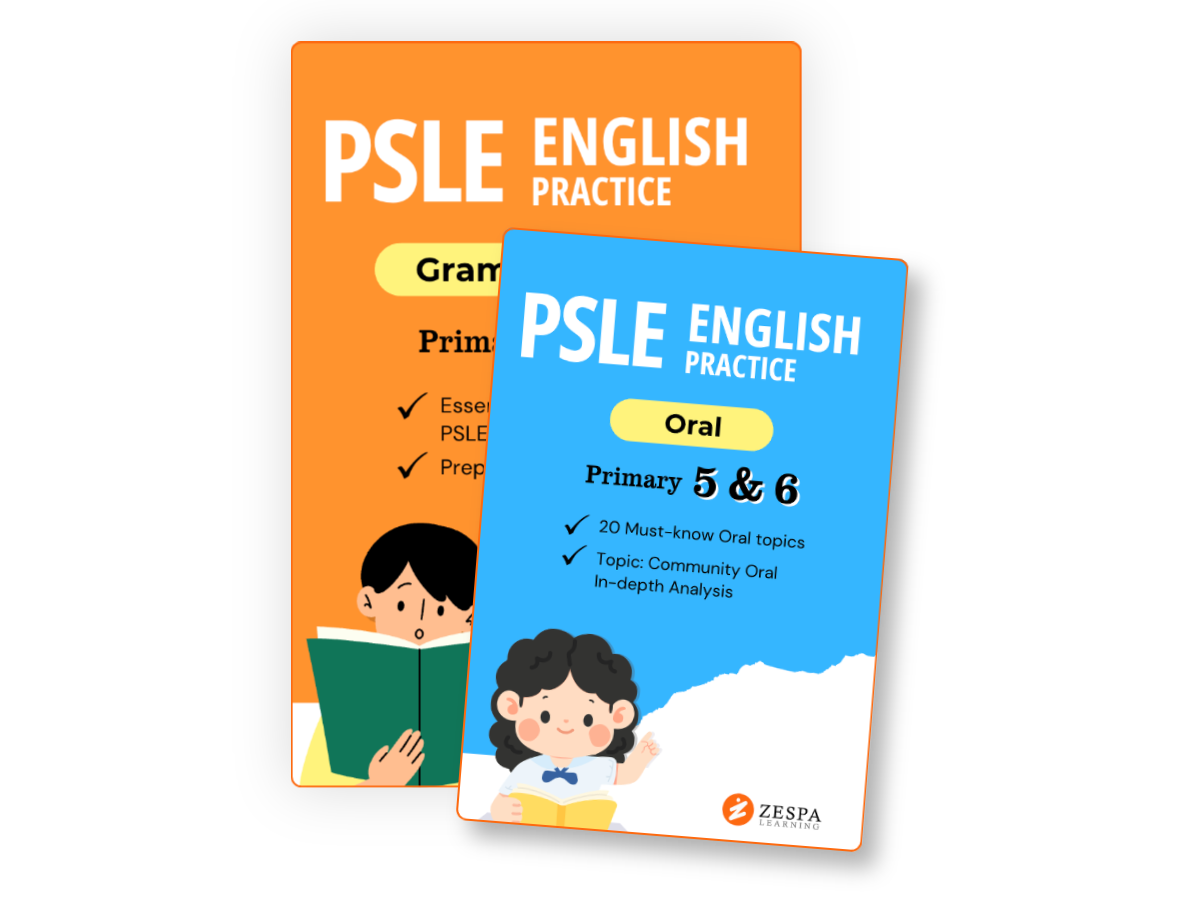
Rather than memorising full responses, students should build flexible ideas and vocabulary across familiar themes. Our free PSLE Oral notes cover commonly tested PSLE Oral topics to support more focused practice.
5. Listening Comprehension Requires Consistent Concentration
The 2026 PSLE Listening Comprehension examination takes place on 15 September, with English scheduled from 11.15am to approximately 11.50am.
Listening may appear more straightforward than Writing or Comprehension, but concentration matters.
Students need to listen carefully for:
- important details;
- changes in information;
- speaker intentions;
- key ideas; and
- differences between similar answer options.
A brief lapse in concentration can result in marks being lost even when the student understands the language well.
For an AL1 target, students should treat Listening Comprehension as an opportunity to secure marks, rather than assuming that preparation is unnecessary.
How Can Students Work Towards AL1 in PSLE English?
1. Identify Exactly Where Marks Are Being Lost
Instead of saying:
“I need to improve my English.”
students should identify a more specific weakness.
For example:
- “I lose marks in comprehension inference questions.”
- “My compositions contain too many tense errors.”
- “My oral answers are too short.”
- “I often miss content points in Situational Writing.”
The more specific the weakness, the easier it becomes to practise effectively.
2. Review Mistakes Instead of Simply Doing More Papers
Completing more worksheets does not automatically lead to better results.
After each practice, students should ask:
- Why did I lose this mark? Identify the mistake.
- What did the question require? Understand the skill being tested.
- What does the stronger answer do differently? Learn the correction.
- Have I made this mistake before? Identify recurring patterns.
- Can I apply this to another question? Check whether learning has transferred.
This makes revision more targeted and prevents students from repeatedly practising the same mistakes.
3. Practise Individual Skills Before Full Papers
Students do not always need to complete an entire English paper.
Targeted practice can focus on:
- comprehension question types;
- grammar and vocabulary;
- Situational Writing planning;
- composition openings or endings;
- Oral topic development; or
- Reading Aloud fluency.
Once individual skills become more reliable, students can apply them during full timed practices.
4. Practise Under Examination Conditions
As the PSLE approaches, students should gradually become comfortable with the actual time limits.
For example, Paper 1 lasts 1 hour 10 minutes, while Paper 2 lasts 1 hour 50 minutes.
Timed practice helps students identify problems such as:
- spending too long planning;
- rushing comprehension answers;
- leaving insufficient time to check;
- slowing down on difficult questions; and
- becoming mentally tired towards the end of the paper.
Students should first learn the correct method, then gradually work on speed.
5. Prepare Every Component, Not Just the Weakest One
Students should certainly spend more time on weaker areas, but an AL1 target also requires consistency.
A strong Paper 2 score cannot completely compensate for avoidable losses across Writing, Oral and Listening.
As the examination approaches, revision should therefore balance:
Strengthen weak areas + maintain strong areas + reduce careless mistakes.
How Zespa Learning Helps Students Prepare for PSLE English
At Zespa Learning, we help Primary 6 students understand where and why they are losing marks, rather than simply giving them more worksheets to complete.
Our PSLE English preparation focuses on:
- structured comprehension answering techniques;
- grammar and vocabulary accuracy;
- Situational and Continuous Writing;
- Reading Aloud and Stimulus-Based Conversation;
- targeted practice for weaker areas; and
- personalised feedback and corrections.
Students learn not only whether an answer is correct, but also what the question requires, why marks were lost and how to apply the correction to future questions.
This helps students develop greater consistency across the different PSLE English components.

Start Preparing Strategically for PSLE English 2026
Scoring AL1 requires consistent performance across Writing, Comprehension, Oral and Listening. In the final stretch, students should focus on fixing repeated mistakes, strengthening weaker areas and applying feedback accurately.
At Zespa Learning, we support Primary 6 students with structured PSLE English practice and targeted feedback to help them approach each component with greater confidence.
Looking for personalised support? Book a free trial class and experience Zespa Learning’s PSLE English programme.