
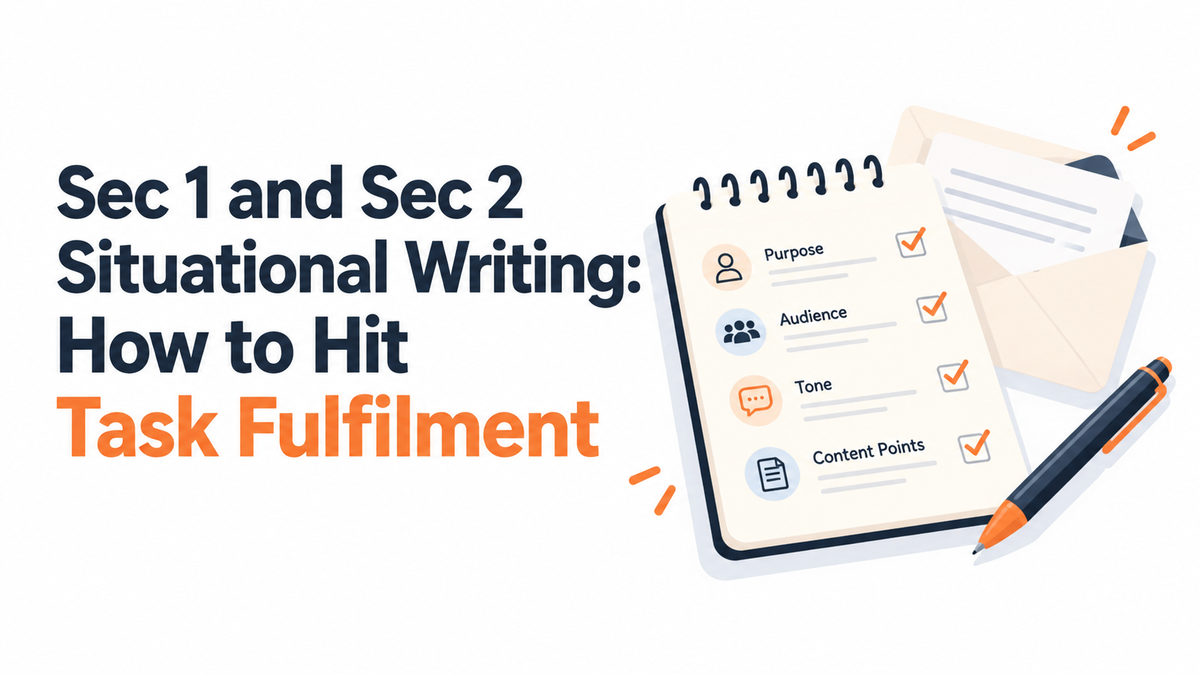
Lower Secondary Situational Writing marks are usually lost before a single sentence is written. The language is fine. The tone is fine. The student simply did not do everything the question asked, and no amount of good writing earns back a requirement that was never answered.
This is the most fixable problem in Secondary 1 and Secondary 2 English, because it is a reading problem rather than a writing problem.
What Situational Writing actually tests
Situational Writing may require a student to write:
- An email to a form teacher
- A letter to a principal
- A speech to a school assembly
- A report for a club committee
Two things are being judged at the same time. The first is language: sentence control, vocabulary, tone. The second is task fulfilment: whether the response actually does what the question set out. Students revise hard for the first and almost never practise the second.
Task fulfilment is where the quick marks are, because the requirements are printed in the question. Nothing has to be invented or remembered. They only have to be noticed, and then covered.
The Three Reads method
Most students read a Situational Writing question once, form a general impression, and start writing. The impression is usually right about the topic and wrong about the details.
Three short reads, done before any writing, fix this. They take about three minutes.
Read one: who and why
Work out the reader and the reason for writing. Ask two questions. Who will receive this? What do I want them to do or understand after reading it?
Eg) A form teacher receiving a suggestion needs different treatment from a principal receiving a request.
- The reader decides tone, level of formality, and how much background to explain.
Read two: what must appear
Go back through the question and underline every instruction. Then write them out as a numbered list on the question paper.
This is the step students skip, and it is the one that carries the marks. A question that says "you should" followed by three points is telling the student exactly how the response will be marked. The list is a checklist, not a suggestion.
Read three: what format carries it
An email needs a subject line and a greeting. A speech needs an address to the audience and a sign-off. A report needs headings or clear sections.
Format is worth doing properly because it costs almost no time.
A worked example
Here is an example of task requirement Secondary 1 and 2 students may see:
Your school is starting a buddy system in which Secondary 2 students are paired with Secondary 1 students to help them settle in. Your form teacher has asked you to write an email to her suggesting how the buddy system should run.
In your email you should:
- suggest two activities the buddies could do together
- explain how the pairs should be matched
- say how the school could tell whether the system is working
Run the Three Reads. Reader: the form teacher, so polite but not distant.
Purpose: To suggest, not to complain or request.
Requirements: Three, and the first one needs two activities, not one.
Format: Email, so it requires a subject line and a greeting.
A weak response
Dear Miss Tan,
I am writing about the buddy system. I think it is a very good idea because Secondary 1 students often feel lost when they first come to secondary school. Everything is new for them and they may not know anyone.
I think the buddies could eat lunch together sometimes. This would help the younger students feel less alone during recess, which is when many of them feel most uncomfortable.
I hope you will consider my suggestion. Thank you very much.
Yours sincerely,
Wei Ming
Check it against the list.
Activities: one given, two required.
Matching: not mentioned.
Measuring success: not mentioned. Two of the three requirements are missing entirely, and the one that was attempted was only half done.
Most of the word count went into explaining why the buddy system is a good idea, which the question never asked for.
A strong response
Subject: Suggestions for the Secondary 1 buddy system
Dear Miss Tan,
Thank you for asking for suggestions on the buddy system. I have set out my ideas below.
First, I would suggest two regular activities. The pairs could eat lunch together once a week during the first month, which gives the Secondary 1 students a fixed person to sit with. The pairs could also spend fifteen minutes together before the first set of examinations, so the older student can explain how the school schedules papers and what to bring.
Second, on matching the pairs, I would suggest matching by co-curricular activity rather than by class. Buddies in the same CCA already share a training schedule, so they will see each other regularly without needing to arrange meetings.
Third, the school could tell whether the system is working by asking the Secondary 1 students a short set of questions at the end of the first term. Two questions would be enough: whether they have met their buddy in the past month, and whether they would know who to ask if they had a problem.
I hope these suggestions are useful.
Yours sincerely,
Wei Ming
Every requirement is covered, and each one is signposted so a marker can find it. The activities are specific enough to picture. The matching suggestion has a reason attached. The measurement is concrete rather than a vague promise to collect feedback.
The language is not more advanced than the weak response. It does not need to be.
Adjacent skills worth building
Specific detail
Once a week during the first month. Fifteen minutes. Two questions. Specific detail is what separates a suggestion that sounds considered from one that sounds invented on the spot, and it is a habit that carries directly into upper secondary writing.
Tone control
Neither response is rude, but the strong one is easier to act on. Suggesting rather than demanding, and giving a reason for each suggestion, is a small shift that shows up repeatedly in Secondary 1 and 2 marking.
Managing time and practice at home
In a timed paper, the Three Reads should take around three minutes. That feels like a long pause when the clock is running. It is still faster than writing four paragraphs in the wrong direction.
At home, the useful drill is not writing more full responses. It is reading ten questions and writing only the numbered requirement list for each. Ten questions take about fifteen minutes and train the exact skill that is being lost.
Then, when a full response is written, check it against the list before looking at anything else. Not the vocabulary, not the sentence length. Coverage first.
Common mistakes to avoid
Explaining why the topic matters. The question rarely asks for justification of the topic itself. Background paragraphs use words that the requirements needed.
Treating a two-part requirement as one. Two activities means two. Students frequently give one good idea and move on.
Covering a requirement so briefly it disappears. A single clause buried mid-paragraph can be missed by a reader scanning for coverage.
Getting the format right and the content thin. A perfect email layout around a response that answers one of three points still loses the content marks.
Writing to the wrong reader. A response to a principal written in the tone of a message to a friend loses marks that the student could easily have kept.
Score better in Situational Writing
If your child loses marks on task fulfilment rather than language, the fastest improvement comes from practising the reading step rather than writing more essays.
Our free Lower Secondary English notes include a situational writing pack with useful phrases and task fulfilment guidance, and the rest of our free English notes cover writing, comprehension and editing across levels.
For structured help, our Lower Secondary English programme works through situational writing with Secondary 1 and 2 students in small groups, with written feedback on coverage as well as language.