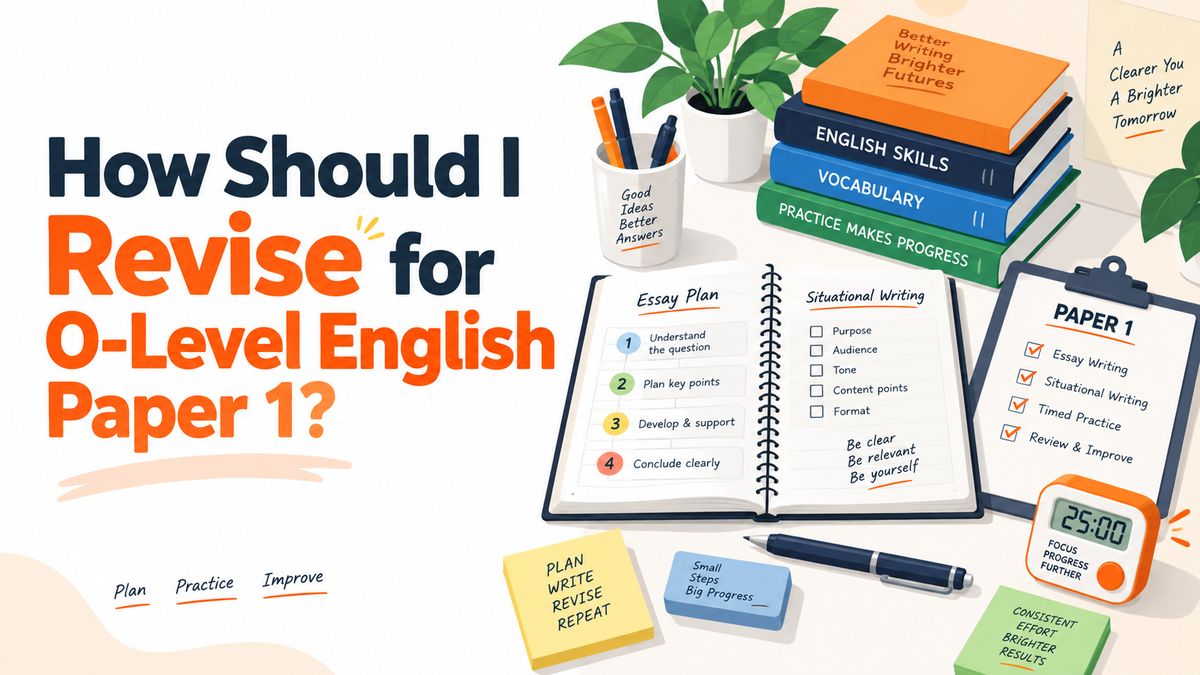
A stronger Paper 1 revision plan should help you identify where you are losing marks, then practise the specific skill behind that weakness.
In this guide, we will look at how to revise each component of O-Level English Paper 1 and what to focus on during the final weeks before the examination.
1. Editing: Stop Relying Only on What "Sounds Right"
Editing is only 10 marks, but it is also one of the Paper 1 components where systematic revision can help.
The official syllabus describes the task as identifying and correcting grammatical errors in a short written text.
One common problem is that students read each sentence and ask:
"Does this sound wrong?"
Language instinct can be useful, but it is not always reliable.
A better approach is to know what types of grammatical errors you should be looking for.
For example, common areas worth reviewing include:
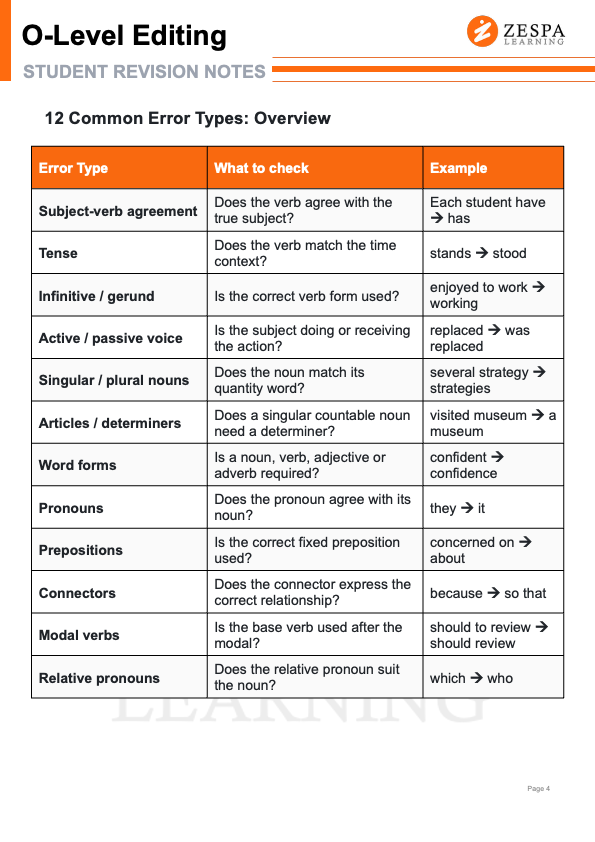
Download our O-Level Editing materials to figure out the common error categories, a checking method and short practices so that students learn to identify why something is wrong instead of merely memorising corrections.
2. Situational Writing: Analyse the Task Before You Write
Before you start writing, establish:
Purpose
Why are you writing?
Are you trying to:
- persuade?
- inform?
- recommend?
- explain?
- request?
- encourage?
Your purpose affects what you say and how you say it.
Audience
Who will read your response?
Compare:
"You should really come along — it'll be fun!"
with:
"I hope you will consider supporting this initiative."
Both may communicate a similar idea, but they suit different audiences.
You should not write to your principal in exactly the same way you write to a close friend.
Context
What is happening?
Who are you supposed to be?
What prompted you to write?
What information from the visual text needs to be used?
Students sometimes include all the obvious content points but fail to adapt them sufficiently to the situation.
Tone
Once you understand the purpose, audience and context, your tone should follow naturally.
Ask:
How should this person sound when communicating with this particular audience for this particular purpose?
A useful framework
Before writing, jot down:
P — Purpose
A — Audience
C — Context
T — Tone
Then check your response against these four areas when you finish.
Do Not Merely Mention the Content Points
Another common Situational Writing mistake is including a point without actually developing it.
3. Continuous Writing: Plan Before You Write
Students sometimes avoid planning because they feel it wastes examination time.
In reality, an effective plan can prevent:
- repetitive ideas
- weak paragraph development
- contradictions
- irrelevant examples
- getting stuck halfway through the essay
Your plan does not need to be long.
For an argumentative essay, it may simply look like:
Stand: Agree to a large extent |
|---|
Point 1: Reason |
Point 2: Reason |
Opposing view: Counterargument |
For narrative writing, your plan could instead map the sequence of events:
Setting → Problem → Development → Climax → Resolution → Reflection
The exact structure depends on the question, but the principle stays the same:
Know where your essay is going before you begin writing it.
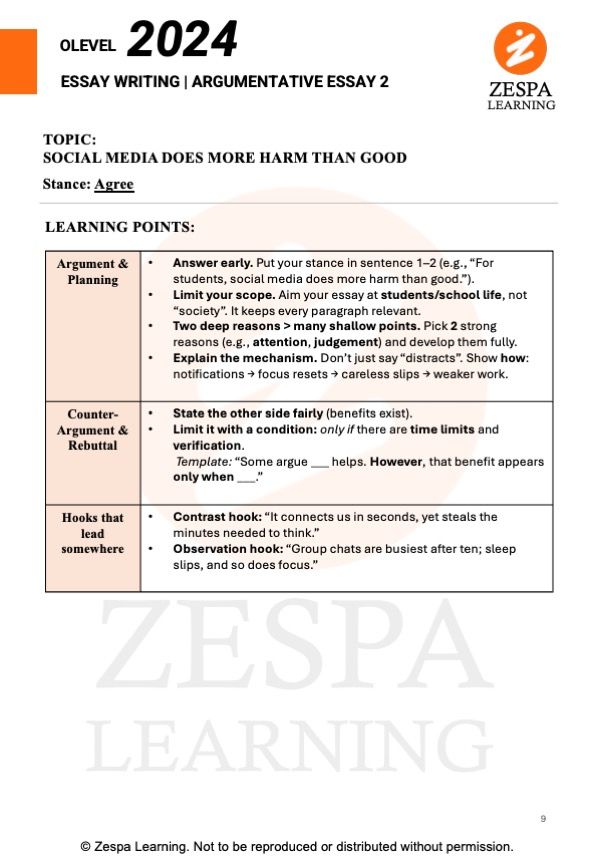
Our Paper 1 resources focus on question analysis and efficient planning before students move into writing the full response.
A Simple Final-Month Paper 1 Revision Routine
You do not need to write a complete Paper 1 every day.
A more focused weekly routine could look like this:
Editing
Complete one or two short practices, then classify every mistake by grammar rule.
Situational Writing
Practise analysing Purpose, Audience, Context and Tone. Some sessions can focus only on planning and developing content points rather than writing the entire response.
Continuous Writing
Practise question selection, essay planning and paragraph development. Complete full essays regularly, but combine them with shorter targeted exercises.
Model Essay Review
Analyse one strong response and extract:
- one structural technique
- two useful expressions
- one effective example or development technique
Correction Session
Return to previous work and rewrite weak paragraphs.
This last step is especially important.
Reading a teacher's correction can make you feel that you understand the mistake. Rewriting the section yourself tests whether you can actually apply the feedback.
Free O-Level English Paper 1 Revision Notes
If you are preparing for Paper 2, we have also organised our O-Level English materials into focused revision resources.