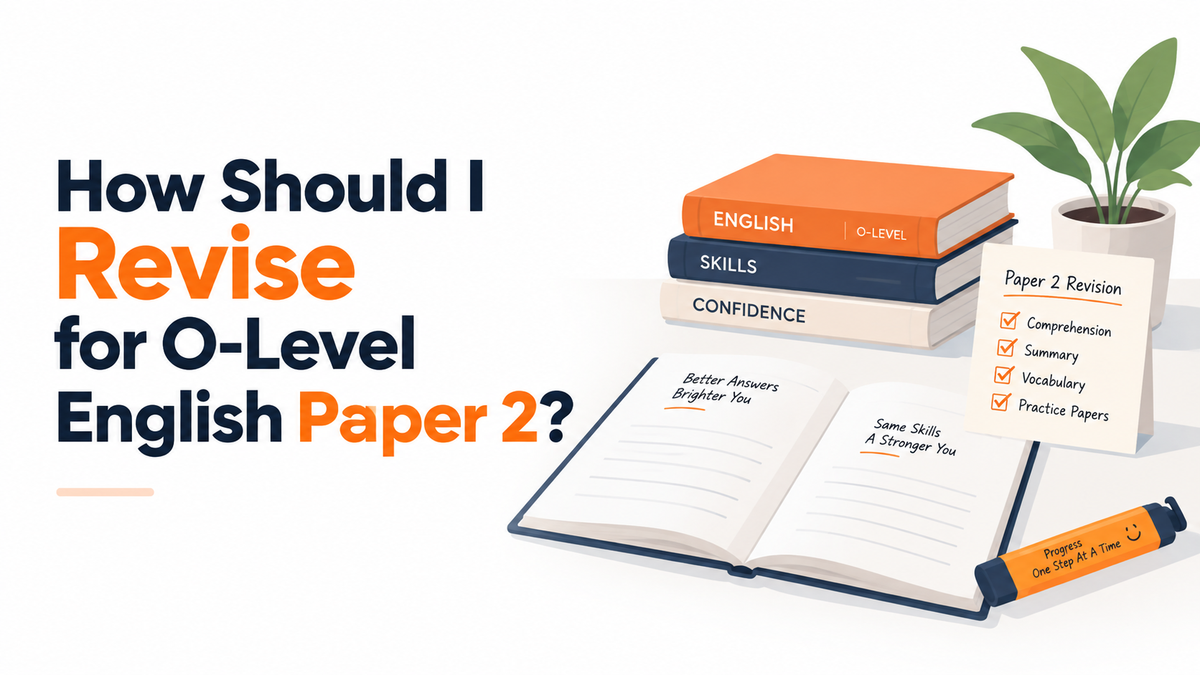
O-Level English Paper 2 can feel unpredictable.
You may understand a passage but still lose marks because your answer is too vague. You may find the correct sentence but include the wrong evidence. Or you may know what the writer means but struggle to express it precisely enough to earn the mark.
The good news is that Paper 2 is not completely random.
The passages change, but many of the reading and answering skills tested remain similar. Learning to recognise these question demands can make your revision much more focused.
This guide explains what to revise for O-Level English Paper 2, common mistakes to avoid, and how to approach the final weeks before the examination.
1. Section A: Learn to Read Visual and Written Information Together
Visual Text questions may appear straightforward, but students can lose marks when they focus only on the words and ignore how the visual elements contribute to the message.
When studying an advertisement, poster, webpage or other visual text, look at how the different elements work together.
For example, consider the headline, image, layout, font size, colours, symbols and supporting text.
Then ask:
- Who is this text meant for?
- What does the creator want the audience to think, feel or do?
- Why was this particular image or phrase included?
The important skill is not simply identifying what you can see.
You need to explain how the visual or written feature supports the purpose of the text.
For example, instead of writing:
The picture makes the poster attractive.
A more precise response might explain what the image represents and how this supports the intended message.
Revision tip
When practising Visual Text, do not immediately answer the questions.
Spend a short amount of time identifying:
Audience → Purpose → Message → Supporting visual features
This makes later questions easier because you already understand the text as a whole.
2. Section B: Narrative Comprehension
Narrative passages often require more than simply locating facts.
You may need to interpret a character's behaviour, infer emotions, explain why particular language is effective or identify evidence supporting an impression.
This is where students sometimes say:
"I understand the story, but I don't know how to answer the questions."
Understanding the general story is only the first step.
You must also recognise what kind of thinking each question requires.
For example, compare these questions:
What did the character do?
This usually requires retrieval.
What does this suggest about the character?
This requires inference.
Which phrase shows that the character was nervous?
This requires evidence.
How does the writer emphasise the character's fear?
This requires language analysis.
All four questions may refer to the same paragraph, but they require very different answers.
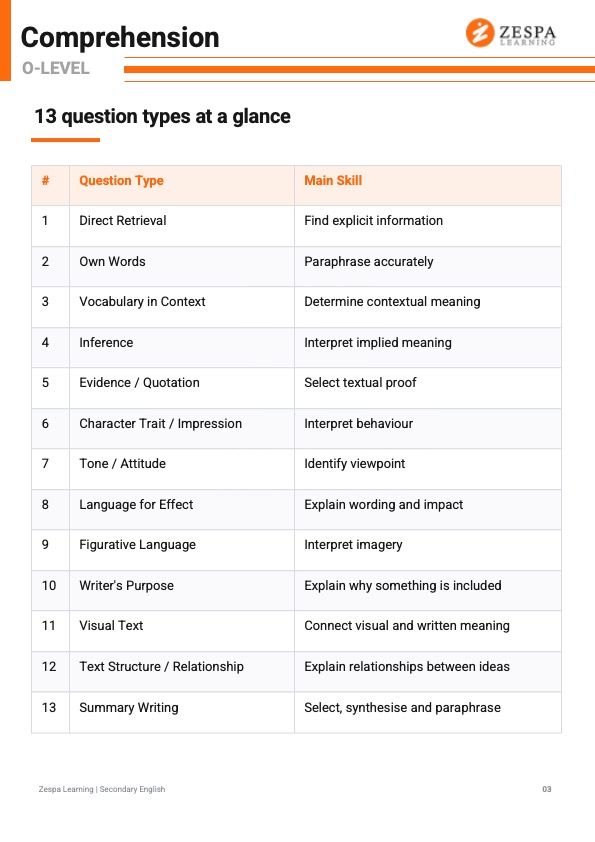
Recognise Common O-Level Comprehension Question Types
In our O-Level Comprehension notes, we organise recurring comprehension demands into 13 practical question types, including direct retrieval, own-words questions, and so on. You can find the full 13 common question types in our free O-Level Comprehension notes.
Paper 2 Is a Set of Skills, Not a Guessing Exercise
The passages in O-Level English Paper 2 will always change.
That does not mean your approach has to change completely every time.
Students can become more consistent when they learn to:
recognise the question demand, locate relevant evidence, distinguish explicit meaning from inference, paraphrase accurately, explain language precisely and select summary points carefully.
Your final month should therefore not be measured only by how many papers you complete.
A better question is:
Am I becoming more accurate at the question types that used to cost me marks?
That is where focused revision can make a real difference.
Free O-Level English Paper 2 Revision Notes
If you are revising Paper 2, we have also organised our O-Level English resources so that students can practise these skills systematically.