How to Prepare for O-Level English in the Final Weeks: 5 Strategies Top Students Use
As the O-Level English examination approaches, many students respond by doing more: more practice papers, more vocabulary lists and more revision notes.
While practice is important, the final weeks are usually not about learning everything from scratch. Stronger students tend to spend this period refining what they already know, identifying recurring weaknesses and making their answers more precise.
The difference often comes down to how revision time is used.
In this guide, we look at five strategies students can use in the final weeks before O-Level English to make their preparation more focused and effective.
1. Review Mistakes Instead of Simply Completing More Papers
Completing full papers can help students build stamina and become familiar with examination conditions. However, doing one paper after another without analysing mistakes may lead to the same errors being repeated.
Strong revision should include a feedback loop:
- Attempt — complete the question independently.
- Review — compare the answer with the expected response.
- Diagnose — identify exactly why marks were lost.
- Correct — rewrite the response.
- Reapply — try a similar question without referring to the correction.
Students should look for patterns rather than isolated mistakes.
For example, a student may discover that they repeatedly:
- provide evidence without explaining the inference;
- give language-effect answers that are too vague;
- overlook part of a Situational Writing task;
- use examples without developing them sufficiently; or
- select relevant summary points but paraphrase them inaccurately.
Once the weakness becomes specific, revision becomes much easier to target.
2. Make Comprehension Answers More Precise
Students do not necessarily lose comprehension marks because they fail to understand the passage.
Sometimes, they understand the general idea but do not express the answer with enough precision.
Strong comprehension answers tend to:
- respond directly to the command word;
- include all required points;
- remain supported by the passage;
- avoid unnecessary information; and
- explain implied meaning rather than simply copying evidence.
Before writing an answer, students should ask:
What exactly does this question require me to explain?
For instance, questions beginning with “What does this suggest?” require students to make an inference. Questions asking “How is this expression effective?” require an explanation of the meaning and effect of the writer’s language.
Recognising these differences can help students avoid losing marks even when they understand the text.
3. Refine Essay Structure Before Trying to Sound Impressive
In the final weeks, students may be tempted to memorise more sophisticated vocabulary or elaborate phrases.
However, impressive language cannot compensate for weak organisation.
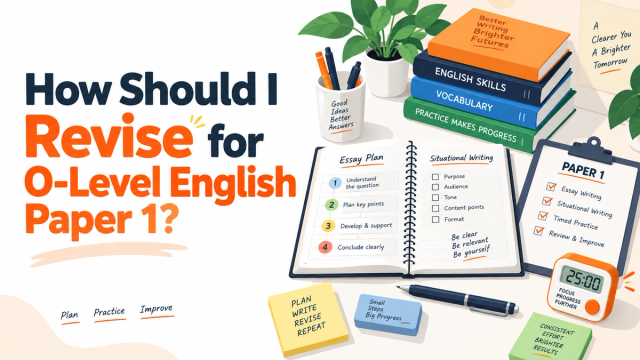
For Continuous Writing, students should first ensure that:
- the question has been answered directly;
- ideas develop logically;
- each paragraph has a clear purpose;
- examples support the main point;
- transitions between ideas are smooth; and
- the conclusion brings the response together.
For Situational Writing, students should also check:
- purpose;
- audience;
- context;
- required content points; and
- appropriate tone.
Vocabulary should support the writing rather than become the focus of it.
A clear, well-developed response using accurate language is usually more effective than an essay filled with complicated expressions that do not fit naturally.
4. Spend More Time on Your Weakest Question Types
Not every student needs the same revision plan.
One student may struggle with inference while another consistently loses marks in summary or Situational Writing.
This is why students should review their previous practices and identify the areas that repeatedly cost them marks.
A simple revision tracker can help:
- Comprehension — which question types cause repeated errors?
- Summary — are points being missed or paraphrased inaccurately?
- Situational Writing — are purpose, audience and content requirements addressed?
- Continuous Writing — are ideas sufficiently developed and organised?
- Editing / Grammar — which grammar errors occur repeatedly?
- Timing — which sections consistently take too long?
Revision should then give more attention to the weakest two or three areas.
The goal is not to practise everything equally. It is to use limited revision time where it can make the greatest difference.
5. Use Feedback to Break Repeated Error Patterns
Some students remain at the same grade despite completing many practices because they are unaware of what is consistently holding them back.
Feedback becomes especially important in the final phase.
Instead of simply seeing:
0 marks
students should understand:
- what the question expected;
- what their answer did incorrectly;
- what was missing;
- what a stronger response would do differently; and
- how the correction can be applied to another question.
The same applies to writing.
A comment such as “develop your example” becomes useful only when the student understands what development looks like and can rewrite the paragraph accordingly.
Students should therefore spend time correcting previous work rather than constantly moving on to new materials.
What Should Students Prioritise in the Final Weeks?
A focused revision plan can be more useful than simply increasing study hours.
- 1. Weak areas — target the skills where marks are repeatedly lost.
- 2. Corrections — revisit previous mistakes and redo them.
- 3. Writing — refine planning, organisation and task fulfilment.
- 4. Comprehension — practise question-type recognition and precision.
- 5. Timing — complete timed sections and full papers.
- 6. Language — review recurring grammar and expression errors.
Students should avoid trying to change their entire approach at the last minute. Small improvements in several repeated weaknesses can often be more valuable than learning many new techniques.
Make the Final Weeks Count
In the final weeks, O-Level English revision should focus on fixing recurring mistakes, improving answer precision and strengthening writing structure rather than simply doing more papers.
At Zespa Learning, students can join our O-Level Comprehension Crash Course for Paper 2 practice or our O-Level Essay Writing Crash Course for Paper 1 revision.
Students can also download our free O-Level English notes for additional revision support.
The goal is to make existing skills more accurate, consistent and reliable before the examination.